AMCAL Multi-Housing — Napkins to Numbers in Minutes

Company: AMCAL MULTI-HOUSING

How AMCAL Multi-Housing turned historical cost data into a faster conceptual estimating workflow with Zebel and Procore Financials

Early-stage projects rarely arrive with everything an estimator would like to have.

Detailed drawings may not exist yet. Quantities may still be changing. Major design decisions may still be under discussion. Yet developers and preconstruction teams still need an early answer to one of the most important questions:

“What is this project likely to cost?”

That is where conceptual estimating becomes critical.

Conceptual estimating allows teams to develop an early view of probable project costs while project definition is still limited. At this stage, estimates may rely more heavily on high-level project characteristics, comparable projects, historical costs, and professional judgment than on the detailed quantities and specifications available later in design. AACE International recognizes this progression through its construction estimate classification framework, where the maturity of project definition is a primary factor in determining the nature of an estimate.¹

For developers and general contractors with years of completed work, this creates an important opportunity: much of the information needed to inform an early estimate may already exist inside the organization.

The challenge is making that information usable without spending days searching through previous projects and rebuilding costs in spreadsheets.

That was the challenge facing AMCAL Multi-Housing.

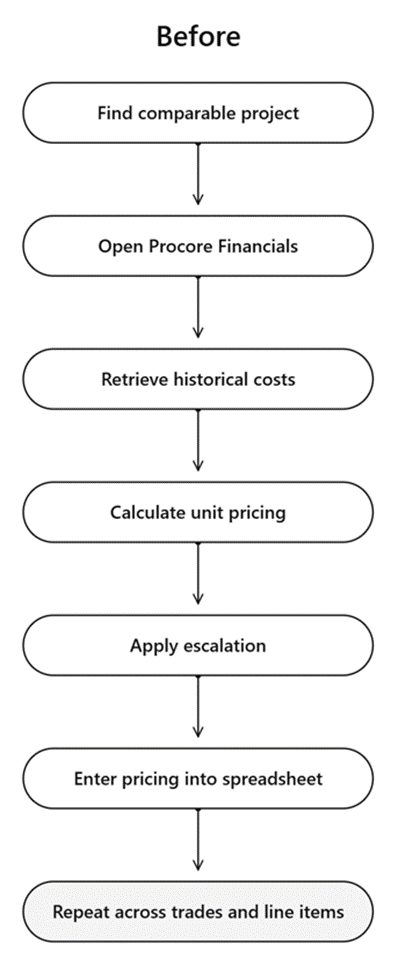
AMCAL relies heavily on historical pricing data to develop conceptual estimates. Previously, using that data required a highly manual workflow: find a comparable project, retrieve its costs from Procore Financials, calculate unit pricing, apply escalation, transfer the numbers into a spreadsheet, and repeat the process across the budget.

A back-of-the-napkin estimate could take a few days to a couple of weeks.

Today, AMCAL uses Zebel together with Procore Financials to turn the same type of historical project intelligence into a conceptual estimate in minutes.

WHAT IS CONCEPTUAL ESTIMATING?

Conceptual estimating takes place when teams need cost information before a project has been defined in enough detail to support a complete estimate.

At this stage, an owner, developer, or preconstruction team may need to determine:

  • Is this opportunity financially viable?
  • What should the preliminary construction budget look like?
  • How does this opportunity compare with projects we have already completed?
  • Which known project characteristics are likely to influence cost?
  • Does the project make enough financial sense to continue development?

The level of information available matters. AACE International notes that estimate classification is closely related to the level of project definition, while other characteristics include the intended use of the estimate, estimating methodology, and the effort required to prepare it.²

This is why conceptual estimating should not be confused with a final bid.

A conceptual estimate supports decisions while information is still developing.

As the project progresses and more scope information becomes available, the estimate can evolve with it.

WHY HISTORICAL COST DATA MATTERS

When detailed quantities and subcontractor pricing are not yet available, previous projects can provide valuable reference points.

The U.S. Government Accountability Office identifies historical data as a foundation of credible cost estimating. Rather than beginning every estimate from zero, estimators can use information from previous projects or programs and adjust it to reflect the characteristics of the new one.³

That principle is particularly relevant for companies with repeat project types.

Every completed project can create useful information about:

  • Total project costs
  • Trade costs
  • Unit costs
  • Cost per square foot
  • Project location
  • Project size
  • Product type
  • Pricing date
  • Actual project outcomes
  • Other characteristics that influence cost

But possessing historical data is not the same as being able to use it efficiently.

Cost information can become fragmented across project financial systems, spreadsheets, previous budgets, estimate files, and other records.

When that happens, an estimator may spend significant time finding and reconstructing information before any meaningful comparison can begin.

The GAO has specifically identified historical cost databases as a mechanism for improving estimating by giving project teams access to costs from completed projects and enabling more meaningful comparisons.⁴

For AMCAL, the historical information already existed.

The bottleneck was turning it into the next estimate efficiently.

AMCAL’S ORIGINAL CONCEPTUAL ESTIMATING WORKFLOW

Headquartered in Southern California, AMCAL Multi-Housing builds affordable, market-rate, student, and workforce rental housing in California, Texas, and Washington.

When AMCAL has DD or CD sets available, the team can source current market pricing from subcontractors.

At earlier stages, however, the team relies heavily on historical pricing data to create conceptual estimates.

The process required the estimator to:

  1. Identify a similar project AMCAL had recently built.
  2. Look up its cost in Procore Financials.
  3. Calculate unit pricing on a square-foot or unit basis.
  4. Apply cost escalation.
  5. Enter the adjusted pricing into the spreadsheet being used to build the new budget.
  6. Repeat the process for every trade and line item.

This approach reflects an established principle of early-stage estimating: historical projects are most useful when they are genuinely comparable and when their costs are adjusted to reflect differences between the historical project and the new opportunity.

Federal construction estimating guidance similarly notes that project-comparison or parametric approaches can use historical costs from similar projects during early planning, while emphasizing that project-specific factors still need to be considered.⁵

For AMCAL, the challenge was the amount of manual work required to perform that process across an entire conceptual budget.

Producing a back-of-the-napkin estimate could take anywhere from a few days to a couple of weeks.

STEP 1: TURN PROJECT HISTORY INTO REUSABLE COST INTELLIGENCE

The first opportunity is not necessarily to change how estimators think.

It is to make the information supporting those decisions easier to use.

AMCAL’s current project cost information lives in Procore Financials. The team can export its latest/current cost data into its historical cost database in Zebel.

This creates a continuous flow:

Current project cost data

Historical project data

Future conceptual estimates

The principle is important beyond AMCAL.

Historical information becomes more valuable when it is preserved in a way that allows teams to compare completed projects instead of repeatedly reconstructing them.

The U.S. Department of Energy’s cost estimating guidance similarly emphasizes the importance of historical cost information, including reference dates and the context necessary to make older costs usable in future estimates.⁶

The objective is not simply to accumulate more project records.

It is to make previous project experience available when the next opportunity appears.

STEP 2: DEFINE THE NEW PROJECT BEFORE SELECTING COMPARABLES

A historical project becomes useful only when the estimator understands how it relates to the proposed project.

AMCAL begins by entering roughly a dozen key parameters describing the new project into Zebel.

These include:

  • Location
  • Site acreage
  • Product type
  • Unit mix
  • Parking ratio
  • Other key project characteristics

This context matters because two projects with similar total square footage can still have materially different cost profiles.

Location alone can affect construction costs through differences in labor, materials, equipment, transportation, and local market conditions. Federal estimating guidance specifically recommends evaluating location and other project characteristics when adjusting historical cost factors for a new project.⁷

The goal is therefore not simply:

“What did our last project cost?”

A more useful question is:

“Which previous projects provide the best cost context for this project?”

STEP 3: SELECT RELEVANT HISTORICAL PROJECTS

AMCAL’s previous process already relied on identifying similar completed projects.

The difference is how those projects are accessed and used.

Previously, an estimator had to identify a similar project, open the relevant information in Procore Financials, retrieve the historical costs, calculate the applicable unit rates, and manually move that information into the new estimate.

With Zebel, AMCAL can select from historical projects already brought into its database.

The estimator still determines which previous projects make sense.

What changes is the amount of work required to retrieve and apply the underlying information.

Historical comparisons are strongest when the reference projects share meaningful characteristics with the new opportunity. GAO guidance on cost estimating similarly emphasizes that analogous and parametric approaches depend on selecting relevant historical data and understanding the cost drivers that connect past projects to future ones.³

Technology does not replace that judgment.

It makes the data behind the judgment easier to use.

STEP 4: PUT HISTORICAL COSTS INTO A COMPARABLE CONTEXT

A project total by itself provides limited information.

AMCAL’s previous process included calculating historical pricing on a square-foot or unit basis before using it in the new estimate.

That transforms:

“Project A cost $X”

into a more useful comparison such as:

“Project A cost $X per square foot”

or:

“Project A cost $X per unit.”

Cost benchmarking relies on the same underlying idea: project information becomes more useful when the costs being compared are placed on a common and understandable basis.

RICS guidance on construction cost analysis and benchmarking emphasizes that cost data should be placed on a comparable basis—including location and price level—before benchmark results are compared.⁸

This does not mean that one unit metric can explain an entire project.

It means that normalized cost information gives estimators another way to understand how historical projects relate to the new opportunity.

STEP 5: ACCOUNT FOR TIME AND COST ESCALATION

Historical costs describe what something cost at a previous point in time.

A new conceptual estimate needs to consider what those historical costs mean for a project being evaluated today or in the future.

AMCAL’s original manual workflow already recognized this. After calculating the historical unit pricing, the team applied cost escalation before entering the information into the new budget.

That adjustment is fundamental to using historical cost information responsibly.

The U.S. Department of Energy notes that applying escalation requires understanding the reference date of the original estimate or cost, the appropriate cost index, and the schedule associated with the future work.⁶

AACE likewise defines a cost estimate as a prediction associated with a documented scope, defined location, and point in time.²

Construction costs also do not move uniformly over time. The U.S. Bureau of Labor Statistics maintains Producer Price Indexes that track changes in prices, including indexes associated with construction inputs.⁹

Engineering News-Record has also maintained historical Construction Cost Index data over an extended period, illustrating why costs from projects completed in different years cannot automatically be treated as equivalent.¹⁰

The takeaway is simple:

Historical cost is evidence.

It is not automatically current cost.

STEP 6: GENERATE THE CONCEPTUAL ESTIMATE

Once AMCAL has defined the new project and selected the relevant historical projects imported from Procore, Zebel handles the remaining work automatically and generates the estimate.

This changes the workflow significantly.

Before:

Find comparable project

Open Procore Financials

Retrieve historical costs

Calculate unit pricing

Apply escalation

Enter pricing into spreadsheet

Repeat across trades and line items

With Zebel + Procore Financials:

Bring current cost data into the historical cost database

Enter key project parameters

Select relevant historical projects

Generate the conceptual estimate

The estimating logic is still grounded in project history and project characteristics.

The difference is the amount of repetitive work required to turn that information into an estimate.

For AMCAL, work that could previously take a few days to a couple of weeks can now be performed in minutes.

STEP 7: BENCHMARK THE RESULT

Generating the estimate is not the final step.

The team still needs to understand whether the result makes sense in context.

AMCAL can instantly compare the estimate with its other projects and with market data Zebel aggregates from other multifamily developers and general contractors.

This creates two useful perspectives.

Internal context

How does the new estimate compare with projects the company has already completed?

Market context

How does it compare with broader cost information available for similar work?

Benchmarking is valuable precisely because an isolated number tells only part of the story.

RICS describes cost analysis and benchmarking as related processes that can inform cost planning and design development.⁸

The U.S. Census Bureau also maintains construction datasets that distinguish between project types, including multifamily residential construction, reinforcing the importance of evaluating construction information within the appropriate project context.¹¹

For AMCAL, the result is a conceptual estimate that can be viewed against both company history and broader market information.

WHAT ACTUALLY CHANGED FOR AMCAL?

AMCAL already had historical data.

It already had completed projects.

It already had experienced construction professionals capable of identifying comparable work and interpreting previous costs.

And it was already using that information to create conceptual estimates.

What changed was the workflow required to turn that knowledge into a new budget.

Before Zebel

Historical information had to be found, retrieved, normalized, escalated, transferred into a spreadsheet, and repeated across trades and line items.

With Zebel

Current cost data from Procore can become part of AMCAL’s historical cost database. The team defines the new opportunity using key project parameters, selects relevant historical projects, generates the conceptual estimate, and compares the result against additional projects and market data.

The methodology did not disappear.

The repetitive work around it did.

WHY ESTIMATING SPEED MATTERS BEFORE DESIGN IS COMPLETE

A conceptual estimate exists to support a decision at a point when the project is still evolving.

That timing matters.

A developer may be:

  • Evaluating a potential site
  • Comparing development opportunities
  • Testing a preliminary product mix
  • Establishing an initial budget
  • Determining whether an opportunity should continue into design
  • Comparing multiple project scenarios

At this stage, waiting several days or weeks for initial cost information can create distance between the question and the decision.

Industry guidance consistently recognizes that early estimates are built with less project definition than later estimates and therefore serve different decision-making purposes.¹

The value of accelerating conceptual estimating is not simply that an estimator completes a task faster.

It is that cost intelligence can enter the development conversation sooner.

THE IMPORTANCE OF CONTEXT WHEN REUSING HISTORICAL COSTS

Historical data becomes most useful when the context surrounding it is preserved.

An estimator should be able to understand:

  • What type of project generated the cost?
  • Where was it built?
  • When was it priced?
  • How large was it?
  • What scope was included?
  • What unit of comparison is relevant?
  • What characteristics materially differ from the new project?
  • Does the cost need to be adjusted for time or location?

Federal cost-estimating guidance emphasizes that credible estimates depend on good data and that historical information should be adjusted when differences exist between the reference project and the new project.³

RICS likewise emphasizes establishing a common basis when comparing construction costs.⁸

This is the difference between simply storing previous budgets and developing historical cost intelligence.

The number matters.

The context behind the number matters just as much.

HISTORICAL COST DATA SHOULD BECOME MORE VALUABLE OVER TIME

Every completed project creates another opportunity to improve the organization’s knowledge base.

Project history can capture:

  • Project characteristics
  • Cost information
  • Unit pricing
  • Location
  • Pricing date
  • Product type
  • Actual/current project costs
  • Other variables that influence future estimates

When that information remains isolated inside individual projects, estimators have to recover it manually every time they need it.

When the information becomes reusable, each completed project can contribute to future estimates.

That creates a continuous cycle:

Build

Capture project cost information

Add it to historical project data

Use that history on future opportunities

Build again

The GAO has previously identified historical cost databases and common cost structures as tools that can support better comparisons and improve cost-estimating practices.⁴

For an organization with years of completed projects, the opportunity is therefore larger than preserving records.

The goal is to turn accumulated experience into something the next estimator can actually use.

A PRACTICAL HISTORICAL COST READINESS CHECKLIST

Before trying to accelerate conceptual estimating, consider whether your existing project history can answer these questions.

Can you quickly find relevant past projects?

If someone asks what a similar project cost, can the team retrieve the information without searching through multiple spreadsheets, folders, and systems?

Do you know what the historical number represents?

Can you identify the project type, location, pricing date, size, and major characteristics associated with the cost?

Can you compare projects on a meaningful basis?

Can costs be evaluated using appropriate measures such as cost per square foot or cost per unit?

Can you account for time?

Do you know when the historical cost was established and whether escalation should be considered before using it for a new opportunity?

Can you account for location?

Do you understand whether differences in labor, materials, equipment, transportation, or local market conditions make a historical project less directly comparable?⁷

Can you reuse current project cost information?

Can today’s project information become part of the historical dataset used for tomorrow’s estimate?

Can you compare multiple projects?

Can the estimator evaluate a new opportunity against more than one relevant historical reference point?

If the answer to several of these questions is no, the organization may not have a shortage of historical data.

It may have a problem making that data reusable.

COMMON MISTAKES WHEN USING HISTORICAL COST DATA

Treating the most recent project as the best comparable

Recency matters, but it is only one factor. Project characteristics, location, scope, and size also affect comparability.

Looking only at total project cost

Two projects with similar total costs can have very different sizes, configurations, and scopes. Unit-based comparisons provide additional context.

Ignoring the pricing date

Historical prices represent a specific point in time. Cost indexes and escalation methodologies exist precisely because prices change over time.⁶ ⁹ ¹⁰

Ignoring location

Construction cost differences can reflect local labor, material, transportation, equipment, and market conditions. Historical costs should therefore be interpreted in the context of where the reference project and proposed project are located.⁷

Using a benchmark without understanding its basis

RICS notes that construction cost benchmarking requires cost information to be placed on a common basis before meaningful comparisons are made.⁸

Assuming software replaces professional judgment

Historical databases and estimating systems can make information easier to retrieve and analyze, but the estimator still needs to determine whether a particular cost, project, or assumption is appropriate for the opportunity. Federal construction estimating guidance similarly cautions against applying database pricing without considering the specific characteristics of the project.⁵

Rebuilding every estimate from scratch

If years of completed-project information exist but estimators repeatedly reconstruct the same historical analysis manually, the organization is not capturing the full value of its own experience.

FROM HISTORICAL COST DATA TO HISTORICAL COST INTELLIGENCE

There is an important difference between having historical cost data and being able to use it.

A company can have years of completed projects and still struggle to answer a simple early-stage question:

“What should this new project cost?”

The value appears when project history can be:

Found

Understood

Compared

Adjusted

Applied

Benchmarked

For AMCAL, connecting Procore Financials with Zebel changed how quickly its existing project history could move through that process.

The team still starts with its own experience.

It still evaluates project characteristics.

It still relies on relevant historical projects.

And it still needs to understand costs in the context of time and the new opportunity.

What changed is the amount of manual work between historical data and a usable conceptual estimate.

The result is the idea behind the original AMCAL story: From napkins to numbers in minutes.

SOURCES

¹ AACE International. (2020). Cost estimate classification system—as applied in engineering, procurement, and construction for the building and general construction industries (Recommended Practice No. 56R-08). https://web.aacei.org/docs/default-source/toc/toc_56r-08.pdf

² AACE International. (2026). Cost engineering terminology (Recommended Practice No. 10S-90). https://library.aacei.org/terminology/welcome.shtml

³ U.S. Government Accountability Office. (2020). Cost estimating and assessment guide: Best practices for developing and managing program costs (GAO-20-195G). https://www.gao.gov/products/gao-20-195g

⁴ U.S. Government Accountability Office. (2010). Department of Energy: Actions needed to develop high-quality cost estimates for construction and environmental cleanup projects (GAO-10-199). https://www.gao.gov/products/gao-10-199

⁵ Whole Building Design Guide. (n.d.). Cost estimating. National Institute of Building Sciences. https://www.wbdg.org/resources/cost-estimating

⁶ U.S. Department of Energy. (2018). Cost estimating guide (DOE G 413.3-21A). https://www.energy.gov/documents/cost-estimating-guide

⁷ Federal Highway Administration. (2026). Estimating handbook. U.S. Department of Transportation. https://highways.dot.gov/sites/fhwa.dot.gov/files/Estimating-Handbook.pdf

⁸ Royal Institution of Chartered Surveyors. (2024). Cost analysis and benchmarking (2nd ed.). https://www.rics.org/profession-standards/rics-standards-and-guidance/sector-standards/construction-standards/black-book/cost-analysis-and-benchmarking-2nd-edition

⁹ U.S. Bureau of Labor Statistics. (2026). Producer Price Index. U.S. Department of Labor. https://www.bls.gov/ppi/

¹⁰ Engineering News-Record. (n.d.). Construction Cost Index history: Annual average. https://www.enr.com/economics/historical_indices/construction_cost_annual_average

¹¹ U.S. Census Bureau. (n.d.). Construction spending: Definitions. U.S. Department of Commerce. https://www.census.gov/construction/c30/definitions.html

Challenge

Solution

Latest from our blog

Understanding ITBs in Construction

If you’ve ever asked, “What is an ITB in construction?”—you’re not alone. An Invitation to Bid (ITB) is a foundational document used throughout the construction industry to initiate...

Construction Work Breakdown Structure (WBS): The Complete 2025 Guide

Managing a construction project—whether it’s a residential build, commercial complex, or public infrastructure—requires meticulous planning.

Contractor’s Guide to Construction Bid Types

Understanding the various bid types is crucial for success when securing contracts in the construction industry. Navigating these bidding processes effectively can make all the difference...

Top Tips for Mitigating Cost Overruns in Construction Projects

Construction projects are known for their complexity, and even the best-planned ventures can experience cost overruns. These overruns aren’t just financial nuisances

Fast Track Your Preon Operation Upgrade

We’ve crafted a solution born from our firsthand experiences as precon professionals. Elevating it to new heights, we’re proud to unveil Zebel—an amalgamation of years of expertise and dedicated R&D, now accessible to all.